

What I learned from re-knitting the same sweater 4+ times
Whether you knit or not, these practical lessons will smooth out the process for just about any hobby.

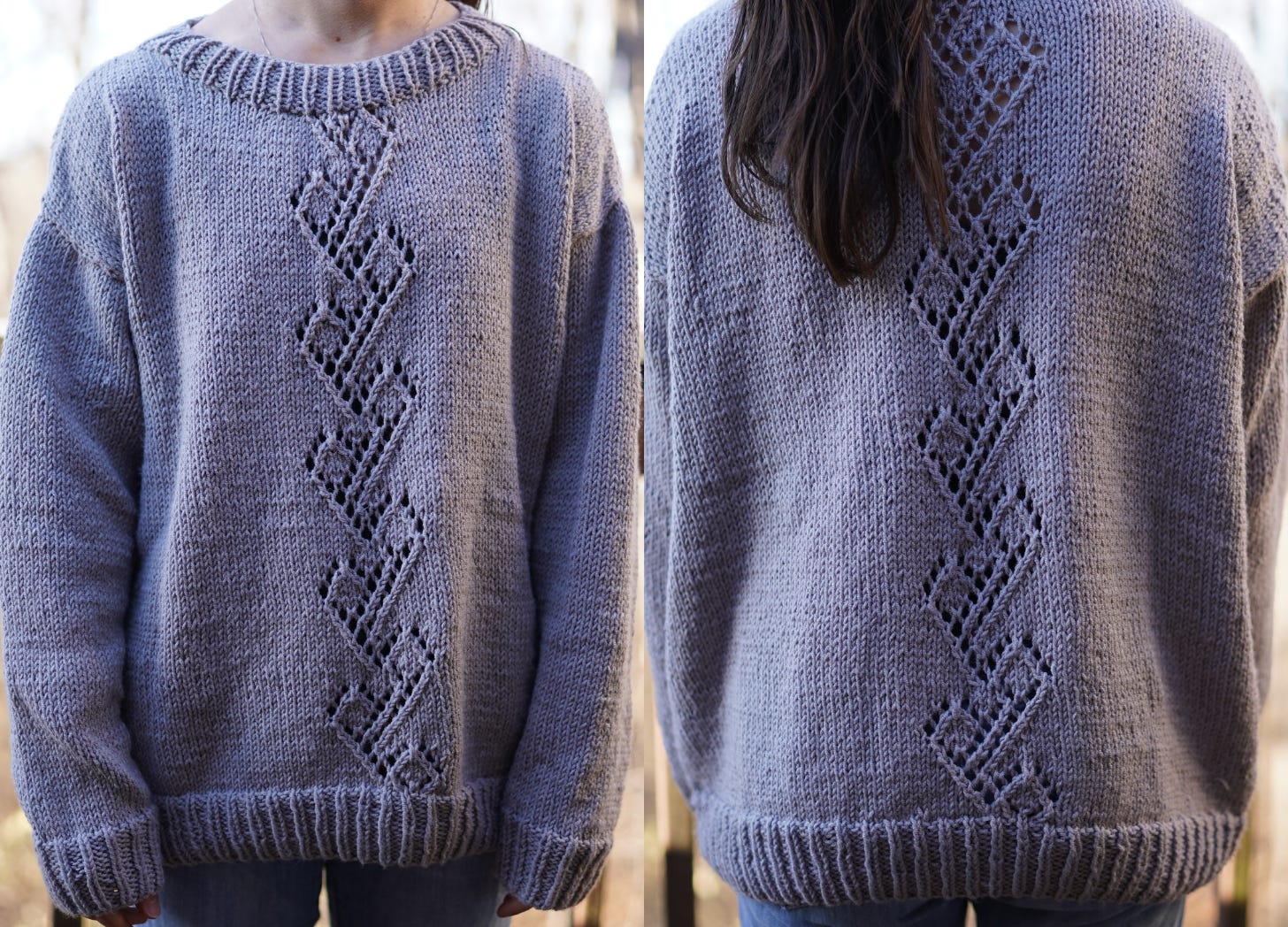
There are multiple sweaters I have hand knit throughout the course of knitting for a year now. None other required as much resilience as the Beatrice sweater, which has a lace knit motif through the center front and back. It’s not that the sweater was inherently challenging; there was just a lot I needed to learn when it came to small techniques that make a large difference and, more importantly, patience.
I believe that just about any hobby can teach hard and soft skills that we can apply to other situations. In the case of this sweater, it definitely taught me a thing (or three). Now, I will share my experience with this sweater (and keep it non-technical for non-knitters) and the key takeaways from it that apply to other projects and life. Hopefully it motivates you to keep going when your project gets tough and learn from the difficulties you encounter to become that much better at your craft.
Lesson #1: Scrutinize the First Steps Extra Carefully
Let me start by saying… this project had issues from the very beginning. When knitting a garment such as a sweater, the first (and most critical) step to take is to knit a gauge swatch. This involves x amount of stitches for x amount of rows with certain size needles, and the goal is to achieve the dimensions specified in the gauge section of the pattern (i.e., 4” x 4”). If your gauge swatch is too small, you size up your needles. If your gauge swatch is too large, you size down your needles. Needle size is only a recommendation; you go with whatever size you need to achieve gauge. There is a lot more to it than that, but that is a general explanation to frame the first issue.
What seemed to have happened when knitting my gauge swatch is it was tensioned tighter than how my tension results further down the piece. So, since my gauge swatch was too small (but probably more so because the fiber content of my acrylic was a bit finer than the acrylic called for in the pattern), I increased my needle size. But because the larger needle size still resulted in a seemingly smaller gauge swatch, I also decided to knit the sweater a size larger than I usually would. This resulted in a sweater that was way too large. But that outcome only happened well after twisting the stiches multiple times (resulting in a twisted garment that needed to have been caught and fixed from the very beginning) and restarting the bottom section over and over. I ultimately decided to rip all this work back and start again from the beginning with a smaller needle size. Scrutinize those first steps extra carefully!
Lesson #2: Apply Sound Technique (And Double Check It)
The next large issue had to do with the lace knit pattern itself. Lace knitting requires absolute precision because any missed stitch technique will result in a lopsided outcome. When I lace knit the middle sections the first couple (maybe even a few) times, I was one or two stitches off. This meant I had to troubleshoot where the mistake occurred and then rip back to that point, which took up to two hours per mistake. That resolution time is much longer than with non-lace knit garments since there is a certain way to handle the lace sections to keep everything intact.
What ultimately solved this problem from continuing to happen (while achieving exactness) was better notation of where the lace knit section actually started each round and counting the stitches after each pattern repeat to ensure the stitch count was as intended. And amid this whole process (especially when seeing how much better the lace knit sections looked with my improved practices), I ripped back another two times! In short: Make a point to use better techniques and double check along way. It doesn’t take that much more time to confirm everything is as it should be, and that extra attentiveness will preserve time, effort, and sanity.
Lesson #3: Step Back to Approach the Problem Differently
After all these unsuccessful attempts with this sweater, I found myself getting frustrated. It was clear that I was going to continue making mistakes unless I took a break from this project, so it was time to set it aside for a bit. I spent the next month working on simpler knitting projects until it seemed like I was ready to come back at it with a fresh perspective.
It can be difficult to let something go for a bit when you’re determined to see the outcome through (especially if your tendency is to keep pressing forward no matter what). Coming back to it at a later date, though, does make a huge difference in how you approach the challenge and what result you end up with.
Successes and Challenges
Now it was time to knit this sweater the fourth time around, and the process and sweater was finally coming along wonderfully! All because I became serious about applying these lessons to this sweater.
The final challenge to bring this sweater to completion was seaming the shoulders of the sweater, the sleeves, and then the sleeves to the sweater. This also took a lot of resilience and patience, as I spent all this time and effort making this sweater, and the last thing I wanted is for the seaming to make the sweater look sloppy.
If all the lessons in this post sound like a whole process, seaming was a whole other process in itself! To make the seams invisible, I had to use a different seaming method for each of those three areas, which required a lot of tutorial watching and re-seaming to achieve the neatness and invisibility I was looking for. And then there came the challenge of getting the sleeves synchronized with the sweater as best as possible, which was like a jigsaw puzzle where the pieces don’t exactly fit. And then using another seaming method to close the extra-large holes in the armpit.
After much trial and error and a week later, seaming was complete. This then meant I needed to sew in the remaining ends, and then there was a finished sweater! What a journey to reach the end.
Final Reflections
If you have gotten as far as you have in this post, maybe it is because you care to keep going when your hobby or project gets tough. There are many lessons to extract from many different experiences, but I think these three are pretty critical to just about anything you may embark on.
For any interests that really inspires you and you want to get good at it yourself, keep pressing on and know that these challenges are part of the process. Keep your mistakes ledger handy and the inspiration behind your hobby at your forefront. Do those two things, and you will most certainly succeed at your hobby in time (whatever that looks like to you).
Happy hobbying!